

How to Choose Between V-Mesh and 358 Mesh for Airport Perimeter Fencing
- Updated: June 15, 2026
- Post Views: 152
- By: Shengsen Metal
If you’re specifying airport perimeter fencing, you’ve probably opened three different supplier websites, read a stack of technical datasheets, and walked away with more questions than answers. One supplier swears by 358 mesh. Another says V-Mesh is what every major airport uses. Both claim to meet “ICAO standards.”
Here’s the thing: both can be right, and both can be wrong — depending on which part of the airport you’re talking about.
We manufacture both products and have supplied airport perimeter fencing to projects across more than 70 countries. Here’s what we’ve learned.
By the end of this article, you’ll know which mesh belongs where, what it’ll likely cost on a real project, and the four questions to ask before you sign a purchase order.
The Short Answer
Use V-Mesh for about 80% of your perimeter — terminal boundaries, cargo areas, employee access, maintenance compounds. When specified as a full system (with proper fixings, toppings, and ground sealing), V-Mesh satisfies ICAO Annex 14, FAA AC 107-2, and every major national aviation standard. It costs less, lasts long, and is the global industry default for good reason.

Use 358 anti-climb mesh for the remaining 20% — fuel farms, runway aprons, ATC compounds, VIP terminals, and any zone with an LPS 1175 SR3+ mandate from an insurer or security authority. The 12.7 mm vertical opening makes it physically impossible for a human foot to get a toe-hold. There is no comparable V-Mesh product that achieves this.
Use both, in a hybrid specification, on any airport with more than 2 km of perimeter. This is not a budget compromise. It is the engineering best practice that experienced airport operators actually use.
That’s the decision in 90 seconds. If you want the reasoning, keep reading.
Why Most Airport Fencing Specs Get This Wrong
Most perimeter fencing decisions come down to one question: “What’s the cheapest product that meets the standard?”
That’s the wrong question. The right question is: “What’s the right product for each zone of my perimeter, and what does the full system cost over its service life?”
Two reasons this matters more than you’d think:
Airports are not uniform. A single perimeter covers zones with fundamentally different consequence profiles. The fence around a fuel farm is protecting human lives and a critical aviation asset. The fence around a maintenance shed is protecting equipment. Treating both the same way is a specification error — whether you over-spec the cheap zones or under-spec the critical ones.
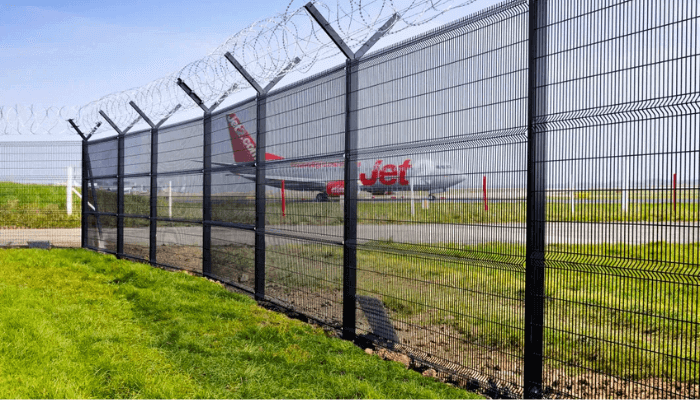
Mesh is only 20% of what makes a perimeter secure. The other 80% is posts, tamper-resistant fixings, top deterrents, ground sealing, and intrusion detection. A V-Mesh panel with shear-off bolts, a concertina razor coil topping, and a fiber-optic detection cable outperforms a 358 mesh panel with standard hex bolts and no toppings. The system matters more than the mesh.
If you’ve been evaluating these two products as if mesh choice is the main decision, you’ve been solving the wrong problem.
The 6 Factors That Actually Drive the Decision
We deliberately left out technical specifications like wire tensile strength and weld shear resistance — your engineer handles that. What you need to compare are the six factors that drive your decision and your budget.
| Decision Factor | V-Mesh (3D Security Mesh) | 358 Anti-Climb Mesh |
| Material cost (2.4 m height, FOB origin, USD) | Low — typically under $60 / linear meter | Higher — typically $70 and up / linear meter |
| Compliance coverage | ICAO Annex 14, FAA AC 107-2, most national civil aviation rules | Same — but also meets LPS 1175 SR3+ system requirements |
| Service life (with proper specification) | 15–20 years (HDG + powder coat) | 20–25 years (HDG-only, well-specified) |
| Annual maintenance (% of capex) | 2–3% | 1.5–2% |
| Risk profile if under-spec'd | Detected intrusion, but rarely a life-safety event | Detected intrusion, often a life-safety event — and an audit failure |
| Best-fit airport zones | Terminal perimeters, cargo, employee areas, utilities | Fuel farms, aprons, ATC, high-value cargo, military co-located facilities |
A note on pricing: The figures above reflect typical 2025–2026 market conditions for FOB origin supply. Your landed cost will include ocean, customs duties, local handling, and installation — which vary significantly by region. Use these numbers to compare the two products against each other, not as a fixed quote.
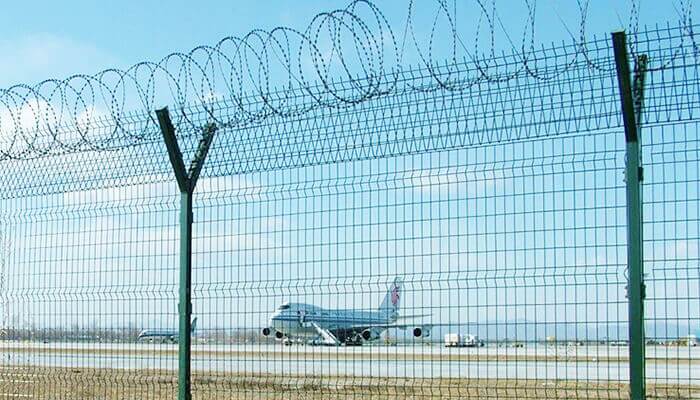
Reading the table honestly: on a 5,000-meter perimeter, choosing 358 mesh over V-Mesh for the full run adds a meaningful amount to your material budget before installation. The exact number depends on your region, your supplier, and your order volume — but the gap is real, and it’s worth knowing upfront. That said, applying V-Mesh to a fuel farm or runway apron is the kind of decision that comes back to bite you in an audit — and audits at airports are not the place to be explaining why you saved money on the wrong mesh.
The hybrid strategy — V-Mesh for the long standard operational zones, 358 mesh for the critical 20% — typically lands within 15–30% of the full V-Mesh cost while satisfying every regulatory and insurance requirement. That’s where most experienced airport operators end up.
Which Mesh Belongs Where: A Zone-by-Zone Breakdown
Here’s how to think about it in terms you’ll actually use in a meeting:
Use V-Mesh when the consequence of a breach is operational, not life-safety. That includes:
- Terminal building perimeters
- General cargo and warehouse areas
- Employee parking and access roads
- Maintenance and equipment storage compounds
- Utility compounds (power, water, telecoms)
Use 358 mesh when the consequence of a breach is life-safety, regulatory, or catastrophic. That includes:
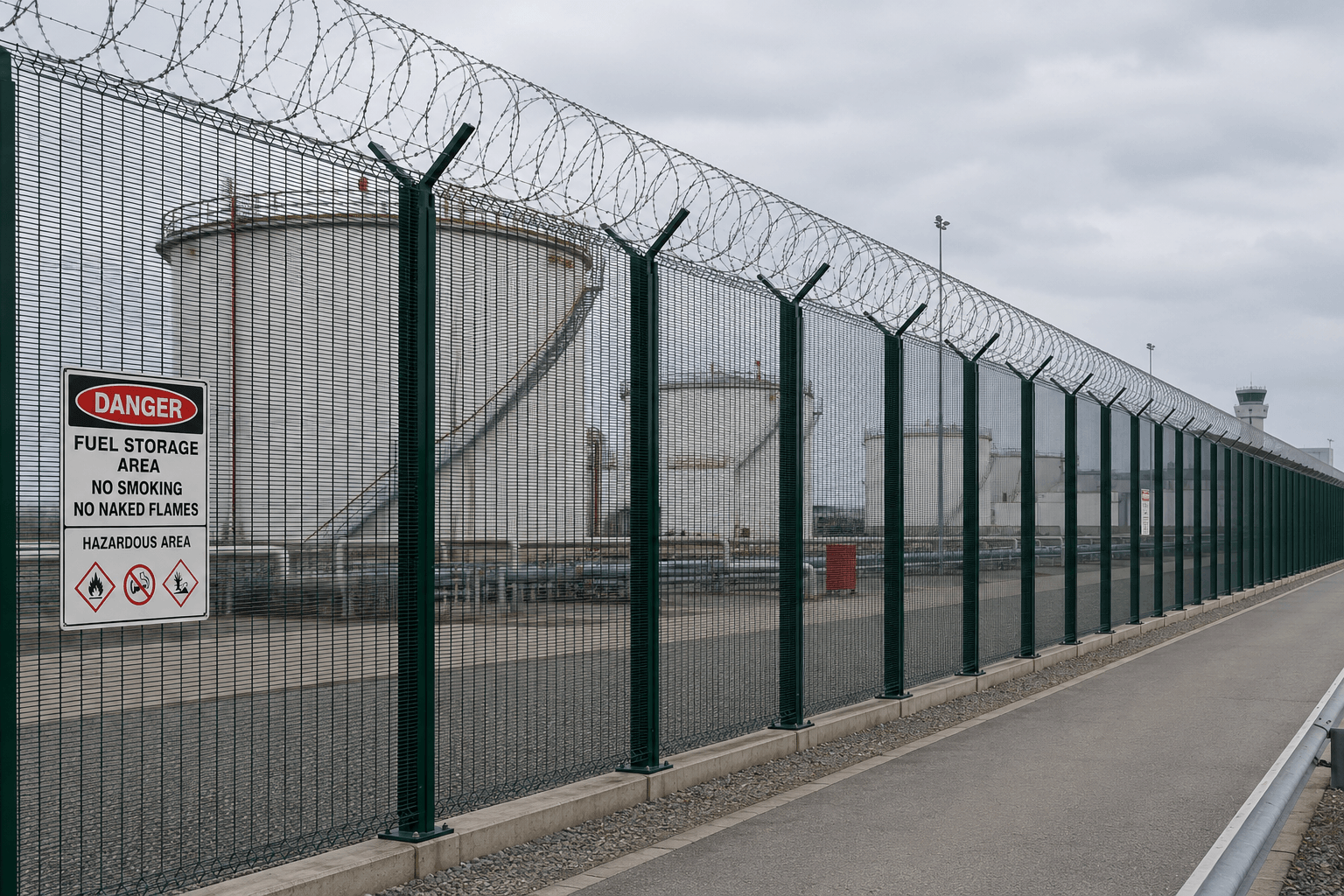
- Aviation fuel farms and refueling transfer points
- Active runway aprons and aircraft parking stands
- Air traffic control compounds
- High-value or high-threat cargo terminals
- Government, military, or VIP-handling facilities
- Any zone where your insurer or national security authority has specified LPS 1175 SR3 or higher
If you’re not sure which category a particular zone falls into, ask yourself one question: “If someone breaches this section at 3 AM, who gets fired — and how fast?” The answer usually tells you which mesh to specify.
5 Things to Know Before You Buy
We’ve seen the same procurement mistakes cost clients six figures and months of project delay. None of them are exotic — they’re all avoidable with a little upfront awareness.
1. Wildlife exclusion is sometimes the actual reason for the spec.
ICAO Annex 14 requires wildlife management, and bird strikes are a multi-billion dollar global problem. The 12.7 mm vertical opening of 358 mesh excludes a much broader species range than the 50 mm opening of V-Mesh. If your airport is in a region with significant bird or small mammal activity — common across Africa, South and Southeast Asia, and parts of South America — this factor alone can determine which mesh you specify.
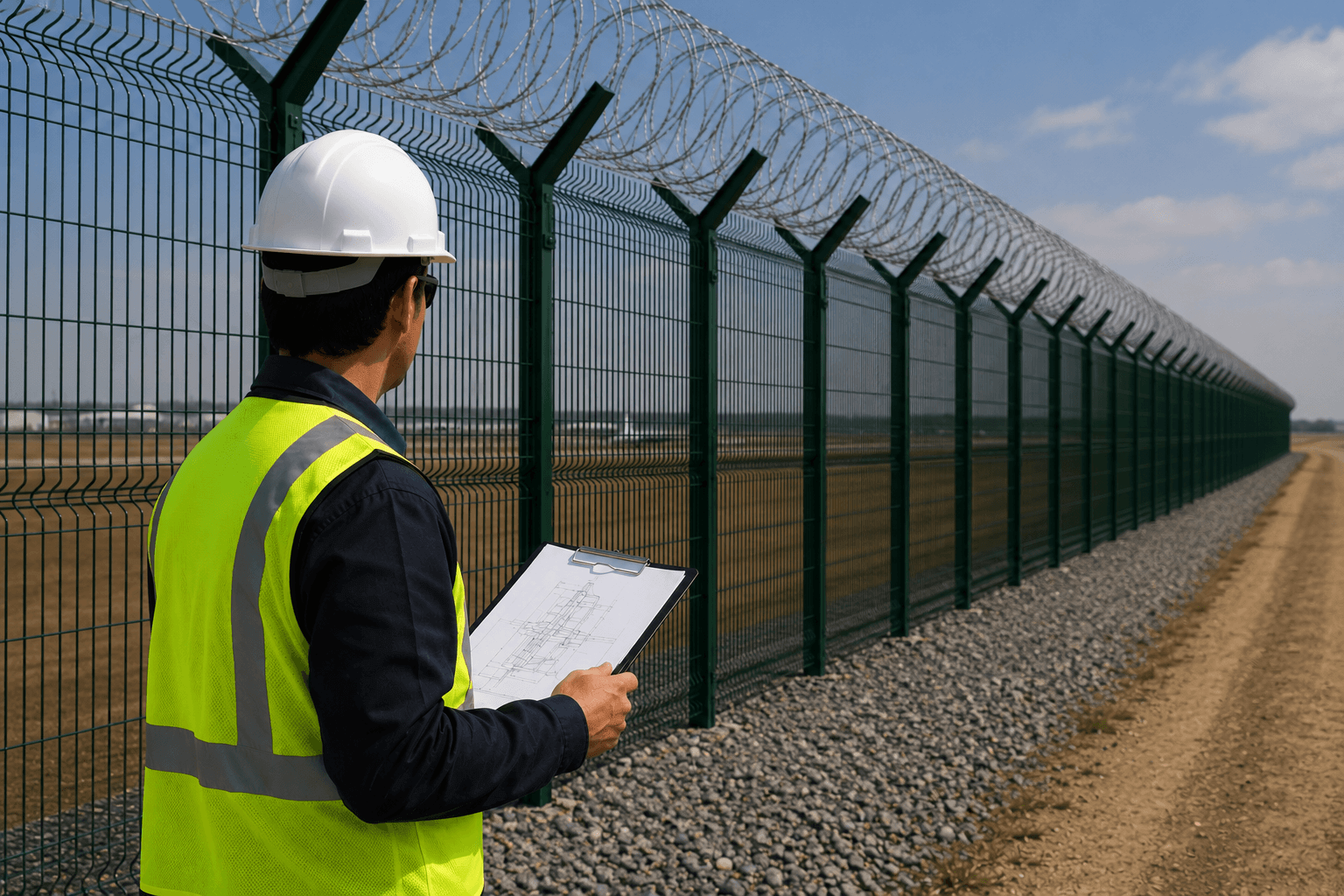
2. A “358 mesh” quotation is meaningless without a mill certificate.
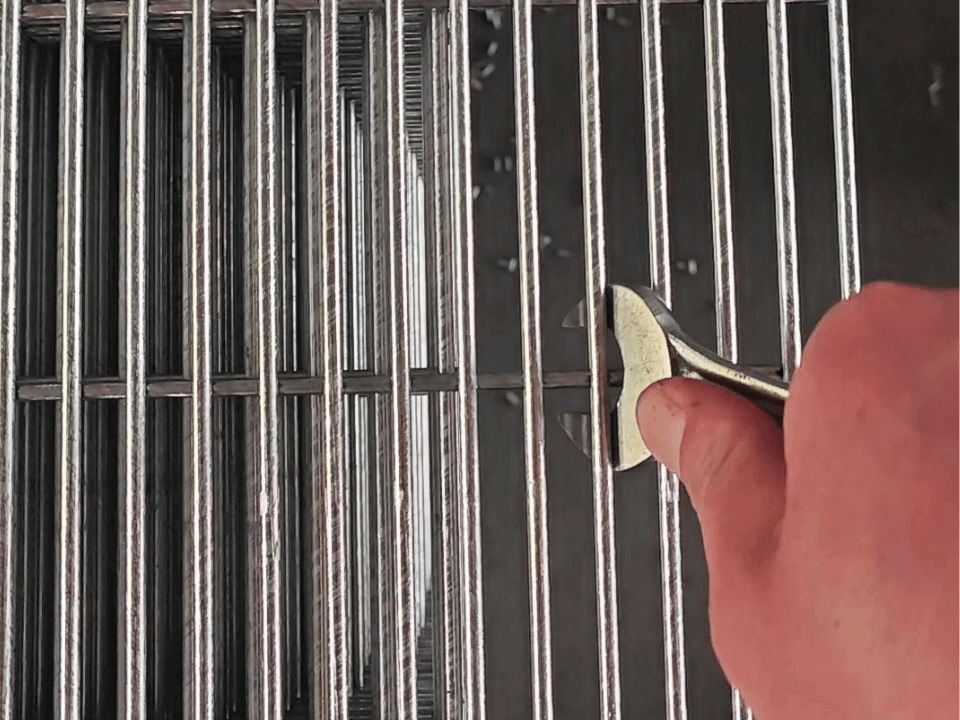
A surprising number of panels in the market don’t actually meet the 76.2 × 12.7 mm aperture. Use a pair of calipers when the shipment arrives. If the aperture is off by more than 0.5 mm, you have a different product, and your compliance claim is gone. When you work with a factory-direct supplier with third-party mill certification — not a trading company re-labeling imported panels — this risk is largely eliminated.
3. V-Mesh specifications are not interchangeable across manufacturers.
The wire diameter (4 mm vs. 5 mm), weld strength, and V-fold depth all vary. Two panels that look identical in photos can perform very differently over 15 years. Ask for third-party test reports — every legitimate manufacturer has them.
4. The savings from cheaper mesh usually disappear the moment you add system components.
A complete airport-grade perimeter (mesh + posts + fixings + toppings + PIDS) typically costs 2.5–3.5× the mesh price alone. Negotiate the system, not the mesh. A 10% discount on mesh is worth a few thousand dollars. A 10% discount on the full system is worth ten times that.
5. Lead times are longer than most teams expect for airport-grade material.
Standard V-Mesh: 4–6 weeks. 358 mesh: 4–8 weeks. Full system: 8–14 weeks. Plus 4–8 weeks for installation on a 5,000 m run. Plan backwards from your deadline date — not forwards from your “we should start looking” date.
A 4-Step Framework for Getting the Spec Right
If you take nothing else from this article, take this:
Step 1 — Map your perimeter into zones.
Walk it. Talk to your operations team. Divide the perimeter into “critical” (life-safety, regulatory, insurer-mandated) and “standard operational” (everything else).
Step 2 — Identify the binding standard for each zone.
Is it ICAO Annex 14 alone? Or does your insurer require LPS 1175 SR3+? Is your national aviation authority prescriptive about mesh type, or is it performance-based? This determines what you must specify, not what you could specify.
Step 3 — Apply the hybrid logic.
V-Mesh for standard operational. 358 mesh for critical zones. Don’t apply one mesh to the whole perimeter out of simplicity — that’s a specification error regardless of which mesh you choose.
Step 4 — Specify the system, not the mesh.
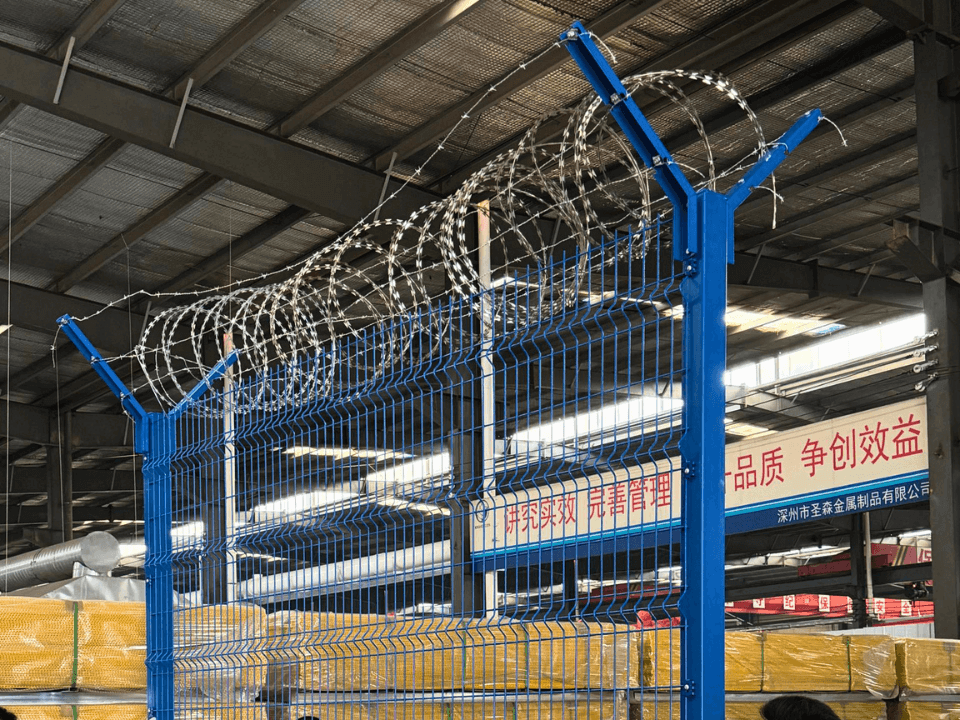
Once you know the mesh for each zone, specify the complete system: posts, foundations, fixings, toppings, ground sealing, and detection. The mesh is one line in a 30-line specification. The other 29 lines determine whether your perimeter actually performs.
We can help you execute Steps 1 through 3 before you go to tender — at no cost, and with no obligation to buy from us. Our specification review is detailed below.
Ready to Spec Your Airport Perimeter?
Most suppliers will quote you a price. We’ll help you figure out what to buy first.
With 20+ years of fencing project experience and airport perimeter supply across 70+ countries, we offer free specification reviews and no-obligation quotes — tailored to your perimeter zones, local standards, and project budget.
Send us your perimeter length, zone breakdown, and any binding standards you’re working under. We’ll come back within two business days with a clear recommendation and a quote you can actually work with.
No commitment. No sales call unless you want one.
Shengsen Metal
Shengsen is a wire mesh specialist. With 20+ years of experience in this industry, Shengsen developed solutions for all your wire mesh needs.

Recent Posts
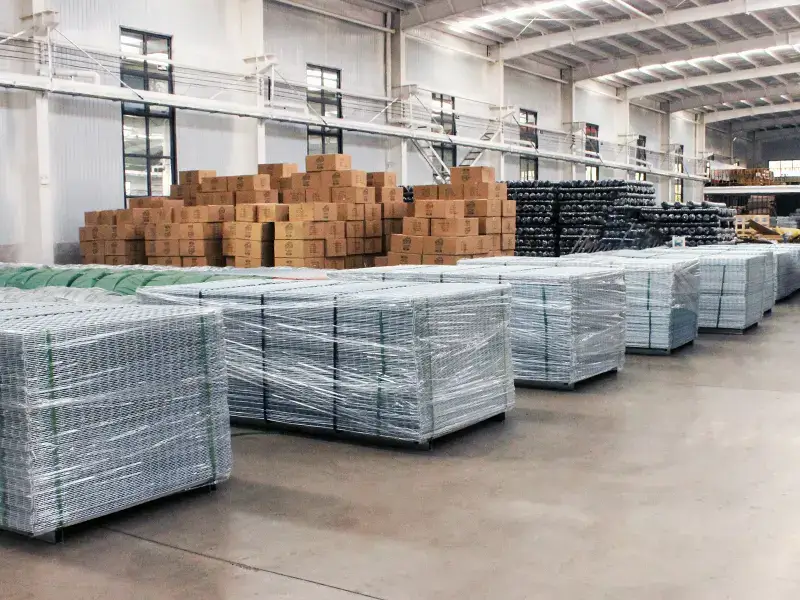
Save More Wholesale From China Factory
Find out if you're buying high with with Shengsen Metal Solution.
You Might Be Interested In
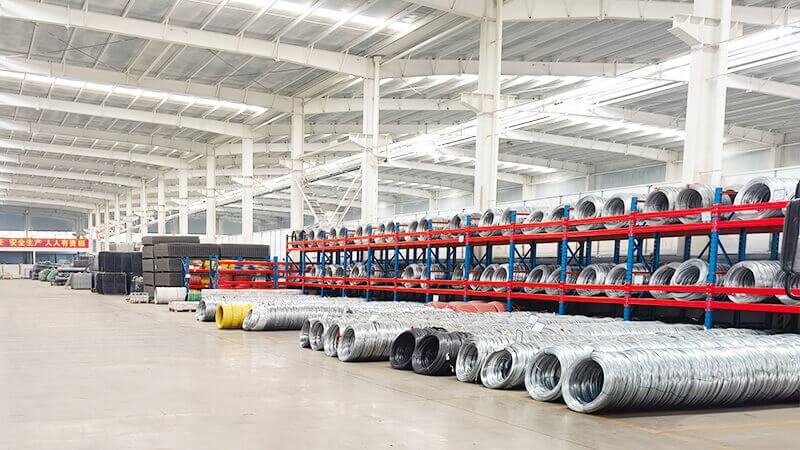
What Are the 4 Main Uses of Galvanized Wire?
Galvanized wire is a versatile product that offers a wide range of applications in various industries. Here are a few of the most common applications: Construction: ...
Read More
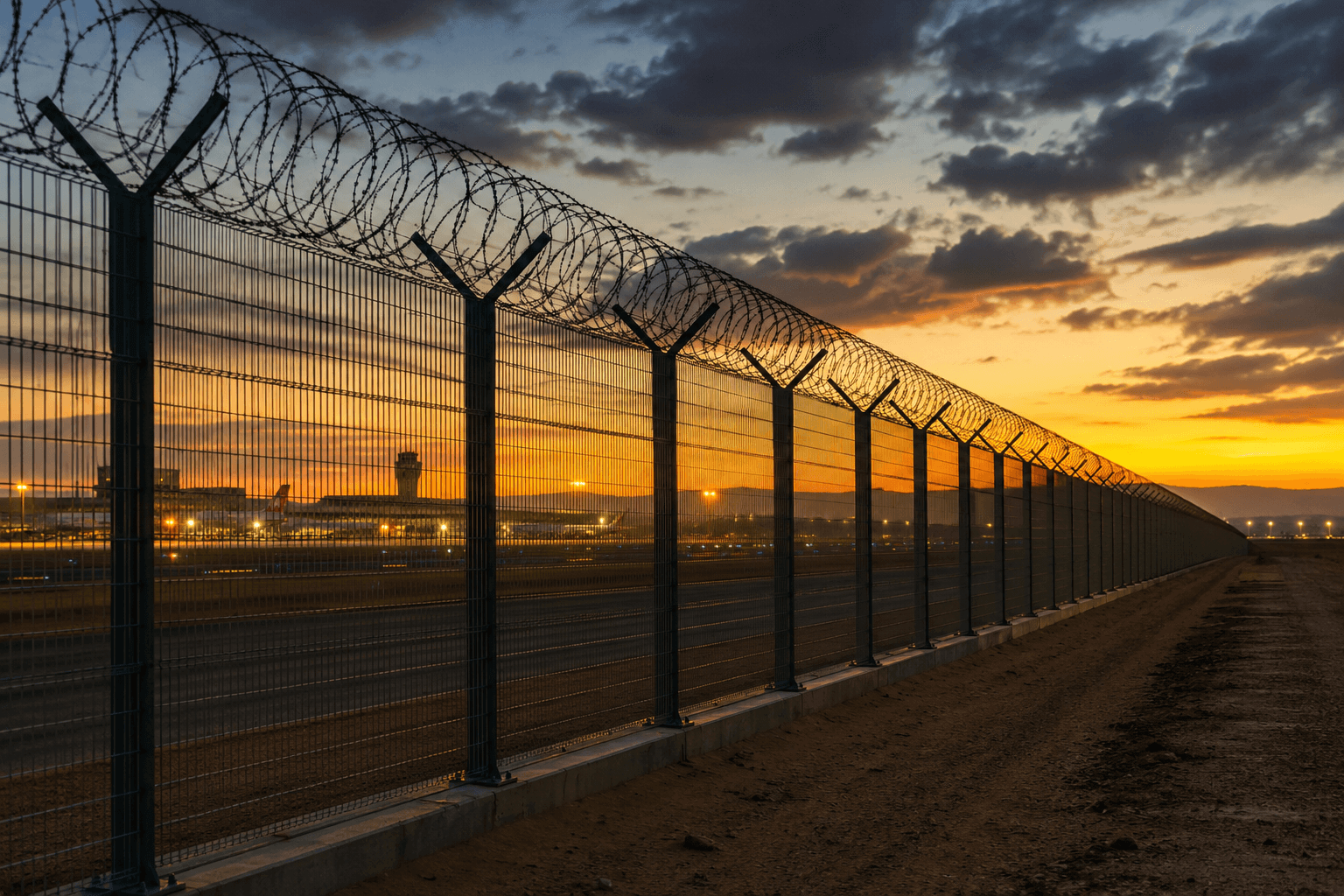
How to Choose Between V-Mesh and 358 Mesh for Airport Perimeter Fencing
If you’re specifying airport perimeter fencing, you’ve probably opened three different supplier websites, read a stack of technical datasheets, and walked away with more questions than ...
Read More
Barbed Wire vs. Razor Wire – What’s the Differences and How to Choose?
As the demand for security measures continues to rise, various protective devices play crucial roles across different industries. Among them, barbed wire and razor wire serve ...
Read More
Uncover New Opportunities with Shengsen Products And Team at the 133th Canton Fair
Dear valued customers and clients, we are excited to announce that Shengsen will be participating in the upcoming Canton Fair, taking place next month from April ...
Read More
Get An Accurate Quote Today!
We help you avoid the pitfalls to deliver the quality and value your wire mesh need, on-time and on-budget.
