

358 Anti-Climb Fencing for Prisons: The Complete Guide
- Updated: September 23, 2026
- Post Views: 7
- By: Shengsen Metal
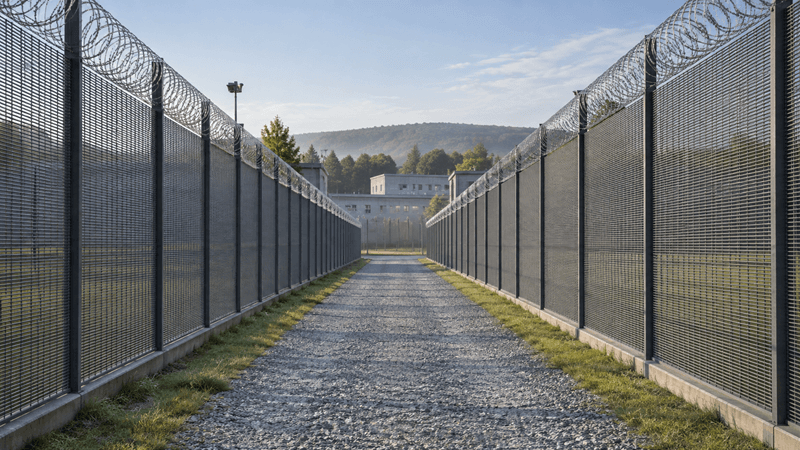
A 358 prison fence uses closely spaced welded mesh to resist climbing and restrict cutting-tool access. Concertina razor wire adds a barrier above it, while posts, fixings and foundations support the complete assembly.
A prison perimeter needs to provide a dependable physical barrier while allowing staff to observe and respond to activity along it. If you are exploring 358 fencing for a project, you may already recognize its narrow mesh pattern. What is less obvious is how much its performance depends on the components around it.
We’ll start with the mesh itself, then explain how the topping, supports, corrosion protection and detection equipment work together. Along the way, we’ll look at the practical details that connect a sound design with a fence that can be manufactured, installed and maintained.
What is 358 anti-climb fencing?
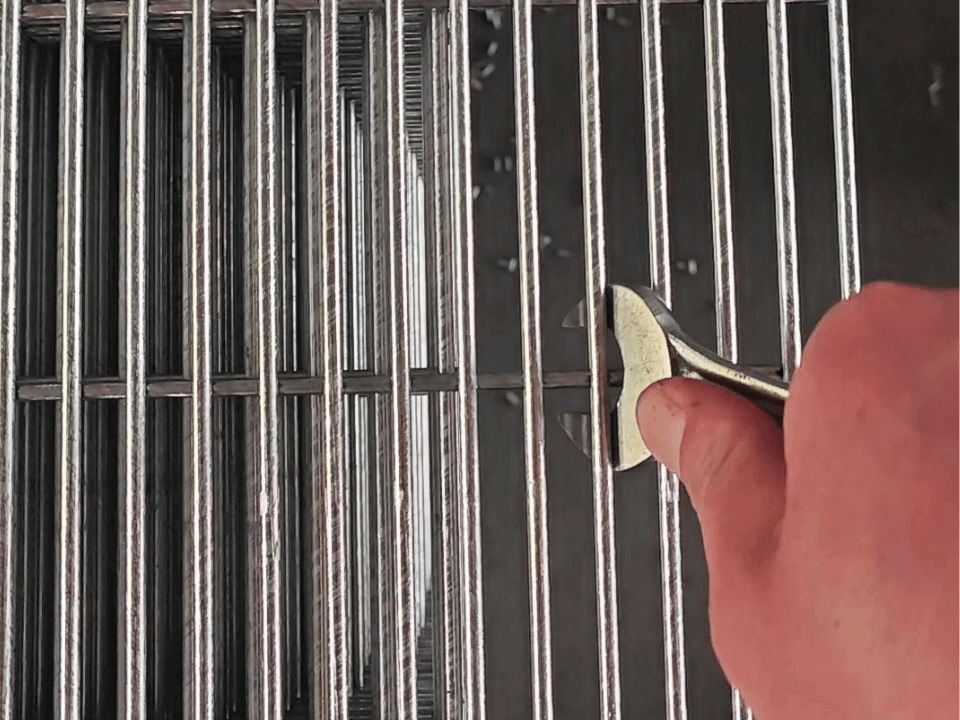
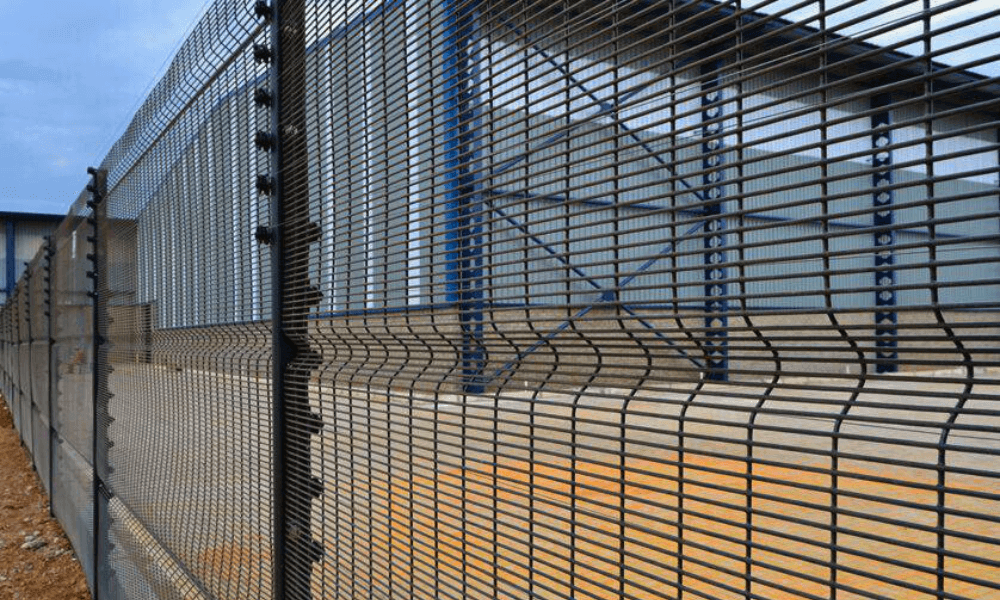
358 fencing is a welded steel mesh system associated with a nominal mesh pattern of 76.2 × 12.7 mm and approximately 4 mm diameter wire. The name comes from the conventional designation of 3 inches by 0.5 inches with 8-gauge wire.
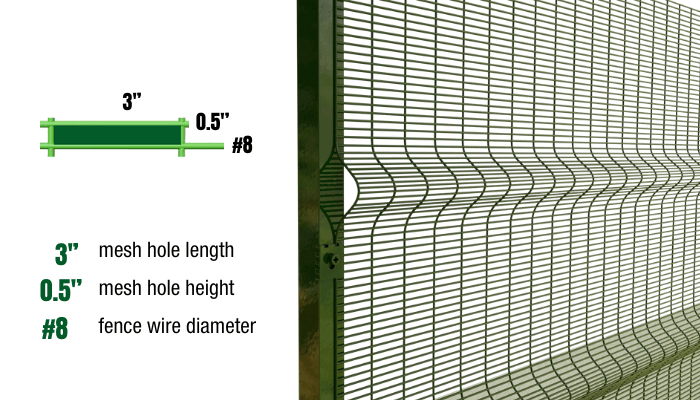
The mesh forms a series of narrow horizontal rectangles. Steel wires are resistance-welded at their intersections, creating a rigid panel that attaches to supporting posts. Published 358 systems use this geometry for climbing and cutting resistance while retaining visibility through the fence.
“358” describes the mesh configuration rather than a complete prison security specification. Panel height, weld performance, post design, connections and topping all influence the finished barrier.
If you have seen slightly different dimensions in suppliers’ drawings, the first step is to check how those dimensions are measured. Centre-to-centre wire spacing and the clear opening between wires describe different things. The drawing should identify the measurement and its permitted tolerance, giving your team and the manufacturer a shared starting point.
With the geometry understood, the next question is what it contributes to a prison perimeter.
Why this mesh is used in prison applications
A correctional perimeter must support containment, observation and an effective response to attempted breaches. The value of 358 mesh lies in how its geometry and construction contribute to those functions.
Climbing resistance

The close spacing between horizontal wires limits the purchase available for fingers and footwear. This makes the panel face difficult to climb without assistance. And for this, the 358 fence is also called anti-climb fence.
The surrounding design matters as well. Posts, brackets, gate hardware and nearby structures should be considered alongside the mesh so that they do not introduce convenient climbing points. The same principle applies when equipment is added to an existing fence.
“Anti-climb” describes resistance. It does not mean that a fence can never be scaled.
Cutting resistance
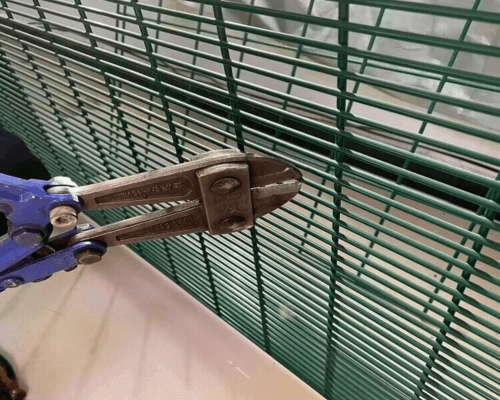
Closely spaced wires restrict the room available to position and operate cutting tools. Wire properties and welded intersections also affect how the panel responds to attempts to create an opening.
There is no sound basis for saying that every 358 panel requires powered tools to breach. Performance depends on the actual construction and attack conditions. Where a defined security rating is required, evidence should cover the proposed system and its tested configuration. NPSA guidance recommends independent testing against a recognized standard for security fences and gates.
Visibility along the perimeter
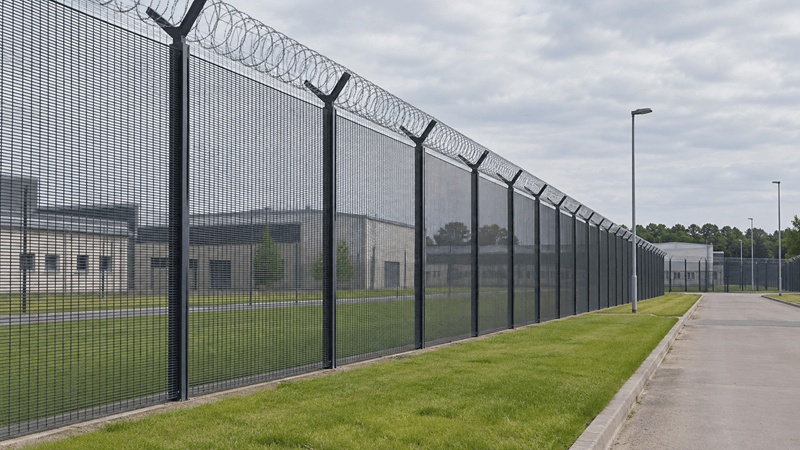
An open mesh barrier allows observation through the fence, which is useful for patrols and surveillance. Visibility nevertheless changes with viewing angle, lighting, fence alignment and the number of mesh layers. This is why this fence is one of the most securied clear view fencing.
For your operating team, the practical question is whether staff and cameras can assess activity at the actual fence line. That deserves attention during the perimeter layout, particularly at corners, gates and locations where two fences overlap in the camera view.
These qualities explain the mesh’s role in the fence face. The next part of the design is the transition over the top, where concertina razor wire introduces an additional obstacle.
How 358 mesh and concertina razor wire work together
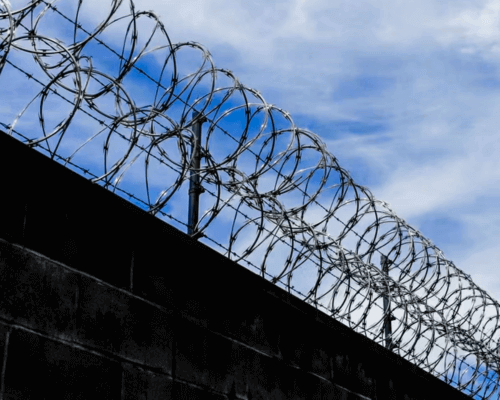
The mesh forms the main vertical barrier. Razor wire extends the obstruction above the panel and makes crossing the top more difficult.
This combination contributes to deterrence and delay. Its operational value increases when attempted interference can be detected and assessed while the barrier is still providing resistance. Physical barriers, detection, surveillance and response therefore need to be planned together.
A prison may use 358 mesh in a single fence line or within a perimeter containing multiple barriers. In a multiple-line arrangement, the space between fences can support observation, detection and controlled maintenance access. The purpose of each line, the available space and the direction of the relevant threat determine the arrangement.
Adding another fence or a larger coil does not establish a particular security level by itself. Each element needs a defined role within the facility’s security design.
Understanding concertina razor wire
Razor wire terminology can be confusing when you first compare products. A blade code, coil diameter and coverage figure each describe a different part of the finished obstacle. It helps to look at them separately before considering how they work together.
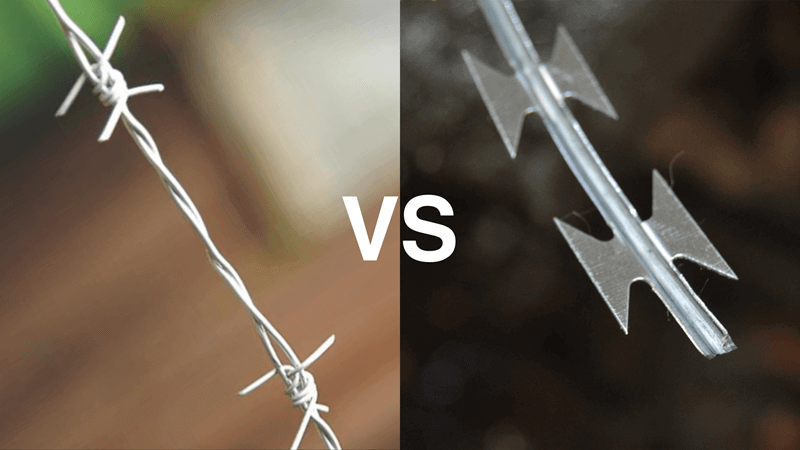
Razor wire, also called barbed tape, uses a metal strip formed into sharp projections. Reinforced products commonly incorporate a steel core wire. The finished topping depends on the blade profile, core wire, coil diameter, number of turns, connections between turns and installed expansion.
Helical and concertina coils
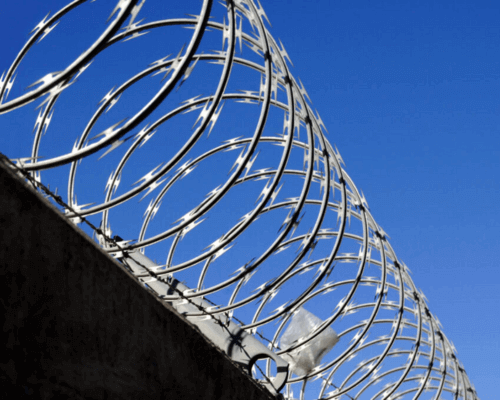
A helical coil opens into a continuous spiral. In a concertina coil, adjacent turns are connected at selected points so that it opens into an interconnected barrier.
Those connections help control the deployed shape. A concertina coil should therefore not simply be described as two separate coils crossed together.
Single coils and multiple-coil assemblies serve different layouts. A multiple-coil arrangement can occupy a greater barrier envelope, but it also changes the support requirements and the space needed for installation and maintenance.
Blade profiles
Designations such as BTO-22 and CBT-60 are used in supplier catalogues to distinguish blade geometries. They should be read alongside a dimensioned product drawing.
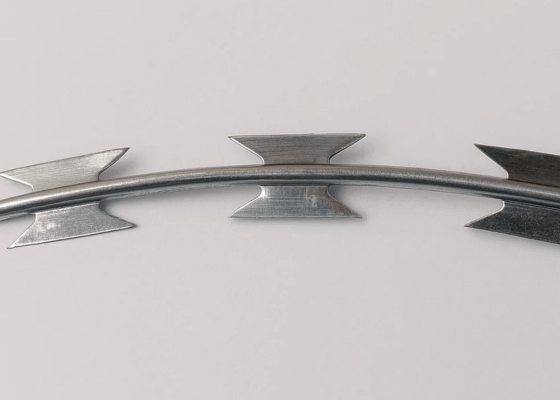
Blade length alone does not establish an independently verified security rating. A profile code does not automatically mean “detention grade” or “maximum-security grade,” either. The installed obstacle also depends on its material, coil construction, attachments and arrangement.
This explains why two products with similar names may not be equivalent.
Coil diameter and expansion
Coil diameter affects the size of the deployed obstacle. Expansion determines the spacing between turns and the length covered by each coil.
The coverage figure needs to belong to a defined installation arrangement. Stretching a coil farther changes its geometry; it does not simply provide more of the same barrier.
If you are comparing two coil options, a drawing showing each in its installed position is often more useful than a photograph of the packed product. It lets you see the intended diameter, spacing and coverage—and gives us a clear basis for discussing the supports with your team.
Materials and standards
The blade strip, core wire and clips may use different materials. A stainless steel blade over a galvanized core is a mixed-material product, so it should not be described as an entirely stainless steel coil.
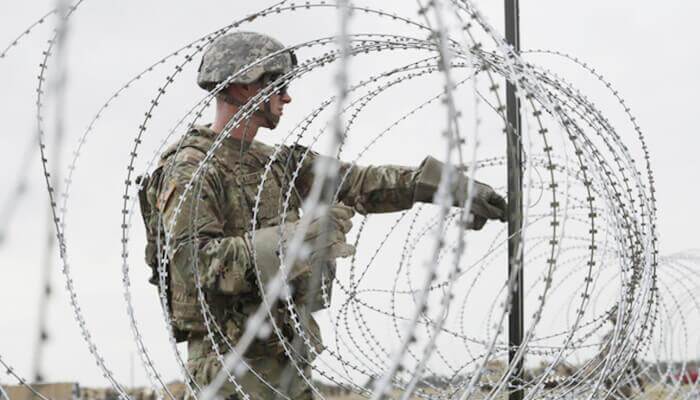
Material selection needs to account for site exposure and the maintenance approach.
Where specified, ASTM F1910 addresses long barbed tape obstacles, while ASTM F1911 addresses installation of barbed tape. Their scopes are distinct, and neither reference alone defines the security performance of a complete prison perimeter.
Once the topping arrangement is established, its position and loads become part of the structural design. This brings us to the connections, posts and foundations that hold the barrier in place.
The structural system behind the mesh
The fence transfers loads through a connected assembly: from panels and topping into fixings, posts and foundations. Each connection needs to preserve the intended behaviour of the system.
Panels and connections
Panel-to-post connections hold the mesh in position and resist separation at the edges. Depending on the system, these may use continuous clamp bars, cover plates or individual engineered fixings.
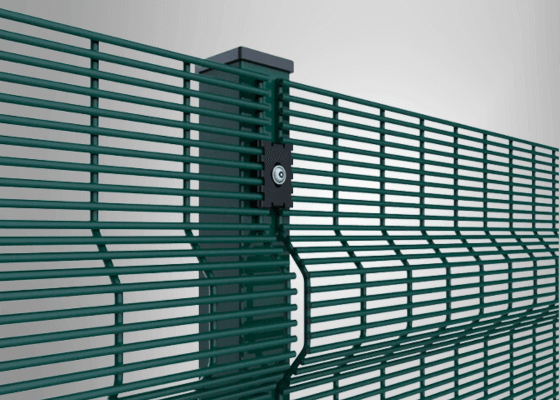
Continuous clamping can distribute restraint along the panel edge. Secure fasteners help resist unauthorized removal, but their effectiveness depends on the complete connection detail, including the supporting post and access to fastening components. Published 358 systems use combinations of overlapping panels, full-length clamp bars and security fixings. 358 panel connection example
Panel joints, corners and changes in level need the same attention as a straight fence run. These are places where the standard detail may need adapting.
Posts and foundations
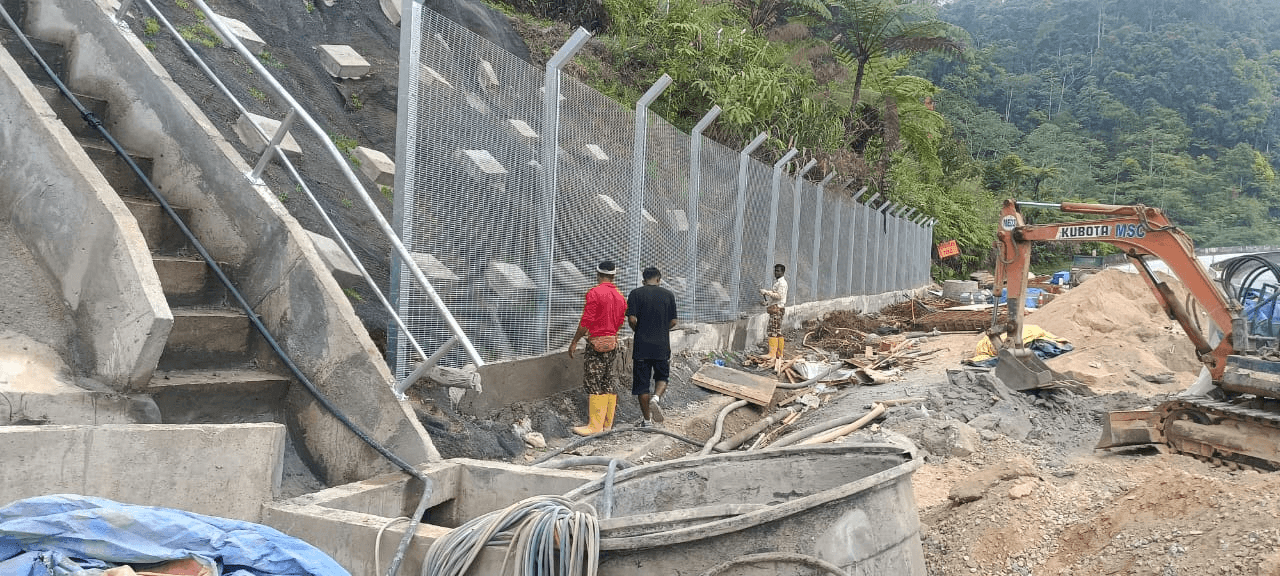
Post design depends on fence height, spacing, topping, wind loading and attached equipment. Hollow sections and purpose-designed profiles are both used.
There is no universal post size or foundation depth for a prison fence. Soil conditions, groundwater, frost effects and structural loads all influence foundation design. Embedded posts and base-plated posts also transfer their loads differently.
If your project changes from one fence height to another, the posts and foundations need to be reviewed with it. A taller panel cannot simply be substituted while assuming the original supports remain suitable.
Vehicle resistance is a separate performance requirement. A substantial-looking mesh fence should not be treated as a vehicle barrier unless the relevant system has been designed and assessed for that purpose.
Topping supports
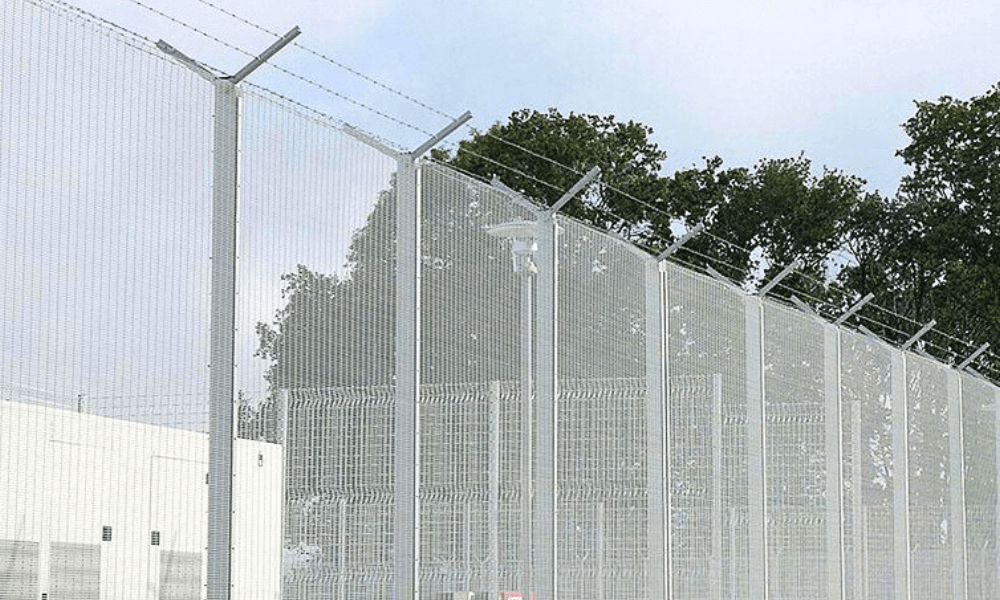
Straight extensions, angled arms and Y-shaped supports position the topping above the fence. Their arrangement determines the location and width of the overhead barrier.
The supports must accommodate the selected coil assembly and its design loads. The load effect depends on weight, projection, attachments and geometry; it cannot be inferred from the blade designation alone.
Where arms are bolted to posts, the joint forms part of the structural design. Where they are welded, the fabrication and coating sequence must account for those welds.
Ground-level protection
The bottom of the perimeter needs to follow the security design as carefully as the top. Ground-level measures may include a concrete toe wall, buried mesh or another engineered detail intended to resist access beneath the fence.
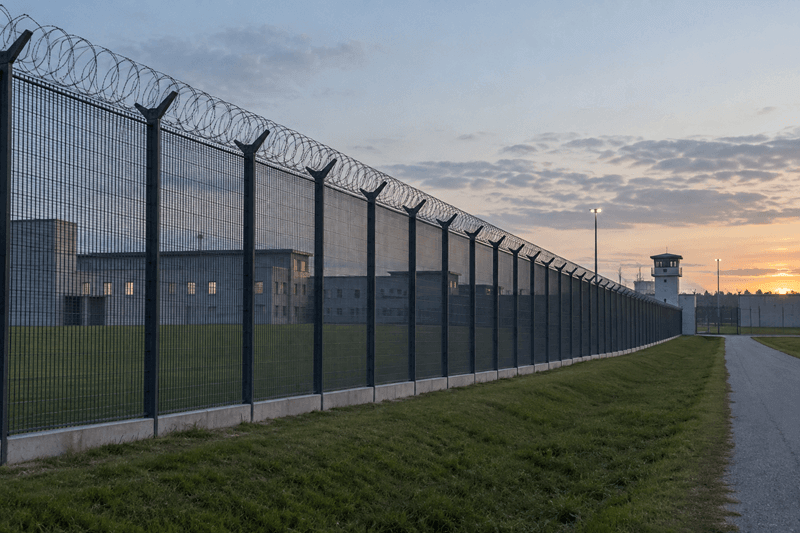
Their effectiveness depends on continuity and site conditions. Drainage crossings, changes in ground level and connections to buildings require particular consideration.
A buried component is one part of below-ground protection. Its presence does not justify a blanket claim that tunnelling has been prevented.
Gates
Gates introduce moving parts and controlled openings into the barrier. Matching mesh infill helps maintain continuity, but gate performance also depends on the frame, hinges, locking system, clearances and adjoining fence connections.
The operating needs of staff and vehicles must be considered alongside security. Access control, emergency procedures and the method of monitoring an open gate all influence the final arrangement.
By this stage, the fence has a defined physical form: panels connected to posts, a supported topping, and coordinated details at the ground and gates. The next consideration is how that assembly will withstand years of exposure at your site.
Corrosion protection and long-term durability
A prison fence is expected to remain serviceable outdoors, often where replacement or extensive repair is disruptive. Corrosion protection is therefore part of maintaining the barrier’s performance.
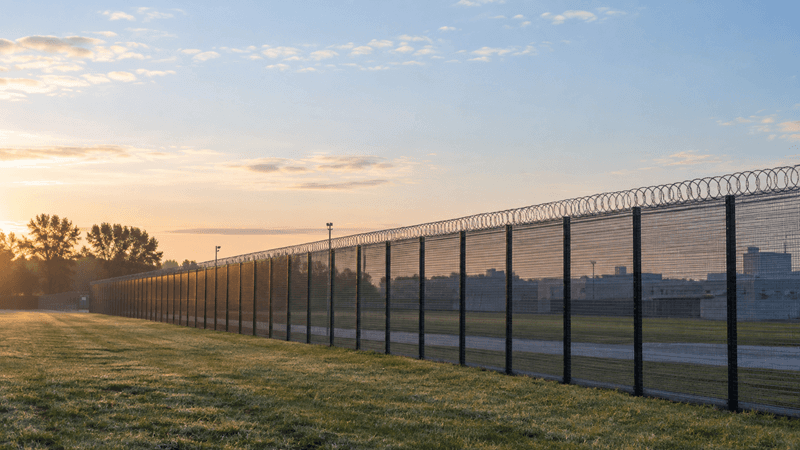
When customers ask us how long a fence will last, the site location is one of the first things we discuss. A coastal installation and a dry inland site can place very different demands on the same steelwork. Salt, industrial contaminants, persistent moisture and local drainage conditions all help shape the material and coating choices.
ISO 12944-2 provides a framework for classifying environments relevant to protective paint systems. That classification helps inform coating selection; it does not, by itself, guarantee a fence lifespan.
Galvanizing and additional coatings
Hot-dip galvanizing after fabrication applies zinc protection to the completed steel component. Other fence systems use galvanized or zinc-alloy-coated wire with additional protective treatments.
Both manufacturing routes exist. The relevant question is whether the complete coating process meets the project requirements, including protection at welds, edges and connections.
ISO 1461 applies to batch hot-dip galvanized fabricated articles within its scope. It explicitly excludes continuously galvanized wire and mesh products, so it should not be used as a blanket reference for every galvanized fence component.
Paint or powder coating may provide an additional protective layer and the required colour. Its performance depends on preparation, adhesion, coverage and compatibility with the underlying surface.
Durability of the complete assembly
Panels, posts, fasteners and topping should be considered together. A durable panel coating does not compensate for unsuitable clips or exposed connections.
Fabrication details also matter. Completing planned welding and drilling before the final protective treatment makes it easier to protect the finished component consistently. Where site alterations are necessary, the affected areas need an approved repair method.
For your team, a meaningful service-life discussion should connect the exposure, coating specification and maintenance conditions. These details provide a more useful basis for planning than a single lifespan figure without context.
Corrosion protection helps preserve the physical barrier. Detection adds another function: making activity at that barrier known to the people responsible for responding. The two systems meet at the fence itself, so their details need to be coordinated.
Integrating perimeter intrusion detection
A perimeter intrusion detection system, or PIDS, identifies activity that may indicate an attempted breach. The physical fence provides resistance while the detection system supports an operational response.
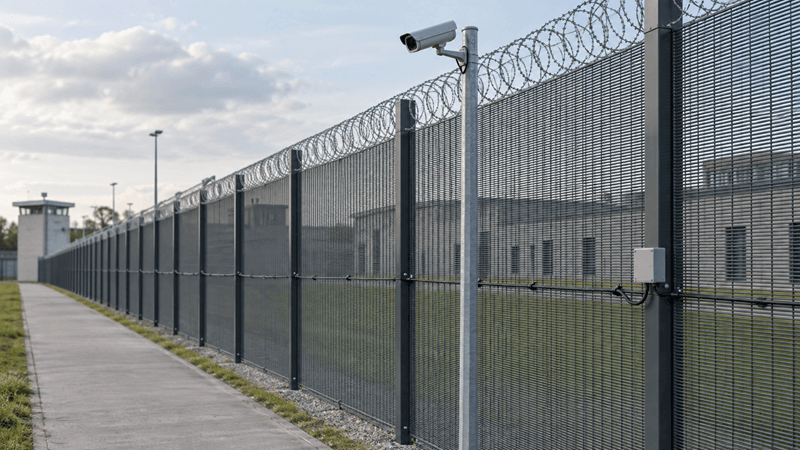
Fence-mounted technologies include fibre-optic sensing cables, other vibration-sensitive cables and accelerometer-based sensors. Their suitability depends on the fence construction and the selected product.
How sensors relate to the fence
Fibre-optic systems detect changes in an optical signal caused by disturbances along the sensing cable. Other cable-based systems respond to movement or vibration through different sensing methods. Point sensors monitor motion at designated locations.
These systems do not all use the same mounting arrangement. A sensor may attach to the mesh, a structural member or another approved location. There is no universal requirement for a carrier wire along a top rail.
You do not need to resolve these mounting details on your own. Your system integrator can define the attachment and cable-routing requirements, and we can use those details when preparing the fence drawings. Bringing those conversations together early makes the transition from design to fabrication easier.
Detection, assessment and response
An alarm needs to tell operators where attention is required and allow them to assess the event. Detection zones, camera views and lighting should therefore be coordinated.
Weather, wildlife, vegetation and loose components can generate unwanted disturbances. System configuration and ongoing maintenance help manage these effects, although no PIDS can promise zero false alarms.
This is also why a well-maintained fence matters to the electronics. The barrier is the physical structure through which many fence-mounted sensors receive their signals.
With the physical layout and equipment interfaces agreed, the design can be translated into production details. Manufacturing quality is what makes those details repeatable across the supplied panels, posts and connections.
How manufacturing quality affects the finished perimeter
The finished panel needs to reproduce the intended geometry and material properties consistently. Wire diameter, spacing and weld quality all contribute to that result.
Welded construction relies on sound intersections. A panel’s appearance alone cannot establish weld performance, just as a smooth coating cannot establish its thickness or adhesion.
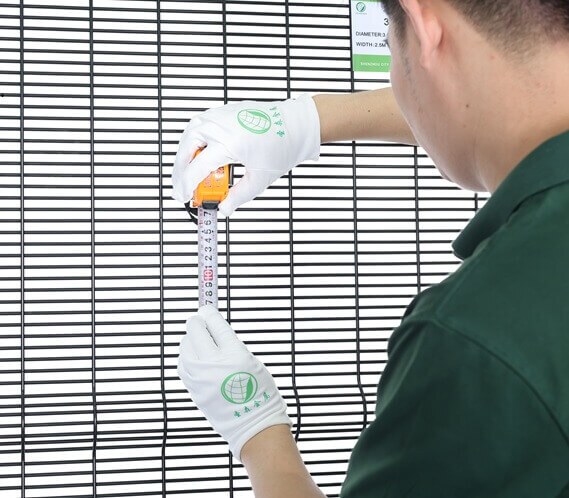
Useful production controls connect the approved drawing to measurable characteristics: dimensions, material properties, weld requirements and coating acceptance criteria. Manufacturing tolerances should be stated clearly. Requiring “no tolerance” is not a practical substitute for defining an acceptable product.
Traceability also has a role. Material records describe the input materials; finished-product inspections address what was actually manufactured. Neither should be assumed to replace the other.
For customers, the different documents can sometimes appear to cover the same ground. It helps to connect each record to a specific question: does it identify the material, confirm a dimension, report a test result or verify the coating? That makes the inspection information easier for your team to review.
Where independent inspection is required, its scope should identify the characteristics to be verified. This gives you evidence tied to the supplied components rather than a general assurance about the factory.
Those checks establish the condition of the components before delivery. Installation brings them together into the finished perimeter, and maintenance helps preserve that condition throughout service.
Installation and maintenance
Installation establishes the final alignment, connections and continuity of the perimeter. Even correctly manufactured components depend on suitable foundations and assembly.
The work should follow the approved system details, including post positioning, concrete strength before loading, panel attachment and topping installation. Razor wire requires trained handling and an installation method suited to the selected product.
Handover should address both the physical fence and any integrated detection equipment. Gates need to operate correctly, connections need to be secure, and coating damage needs attention.
During service, inspection should cover movement or settlement, loose fixings, damaged mesh, corrosion, topping attachments and gate alignment. Vegetation and accumulated debris also need control where they affect visibility or detection.
Maintenance access deserves consideration during design. Your operating team will need to inspect and service the perimeter after the installation team has left. Components that can be reached, inspected and repaired safely are easier to keep in their intended condition.
Common questions about 358 prison fencing
Is every 358 fence suitable for a prison?
No. The mesh designation alone does not establish suitability. The complete system must meet the facility’s security, structural and operational requirements.
What height should a prison fence be?
The height comes from the approved security design and the relevant authority’s requirements. Drawings should distinguish the mesh height from the overall height including topping.
Does a larger razor wire blade mean better security?
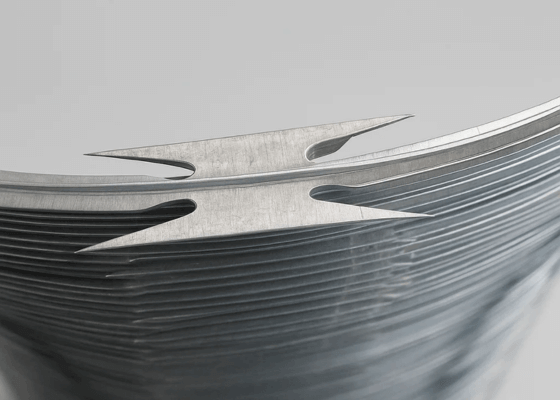
Blade geometry is one factor. Coil construction, installed arrangement, materials and attachments also matter. A larger blade does not automatically establish a higher tested performance level.
Can existing 358 fencing accept detection equipment?
It may be suitable, subject to a review of the fence condition and the sensor manufacturer’s requirements. Loose panels, unsuitable attachment points or inconsistent construction may need attention before commissioning.
How long will the system last?
Service life depends on exposure, materials, coatings, installation and maintenance. A useful estimate needs those conditions to be defined, together with what is meant by service life—for example, time to first major coating maintenance.
What if some project details are still being developed?
An early layout can still support a useful technical discussion. It helps to distinguish confirmed requirements from details awaiting approval, so the manufacturer, engineer and integrator can work through their respective parts without treating an assumption as a final decision.
Bringing the system together
358 mesh forms the main barrier, but a prison perimeter depends on how the whole system works together. Secure connections, suitable foundations, coordinated topping and effective detection each contribute to its performance. Corrosion protection and maintenance help preserve that performance over time.
From a manufacturing perspective, the details that deserve the most attention are often where components meet: panel to post, coil to support arm, fence to ground, and sensor to mounting point. Resolving those connections clearly helps carry the design through fabrication and installation.
If you are working through these details for a project, we’re happy to discuss them with you, whether you have an early layout or a finished specification.
Shengsen Metal
Shengsen is a wire mesh specialist. With 20+ years of experience in this industry, Shengsen developed solutions for all your wire mesh needs.

Recent Posts
Save More Wholesale From China Factory
Find out if you're buying high with with Shengsen Metal Solution.
You Might Be Interested In
Oval Wire vs. Galvanized Wire: What Are the 7 Differences
Introduction Oval wire vs. galvanized wire, they are two types of steel wire that are commonly used in a variety of applications. Each has its unique ...
Read More
Barbed Wire vs. Razor Wire – What’s the Differences and How to Choose?
As the demand for security measures continues to rise, various protective devices play crucial roles across different industries. Among them, barbed wire and razor wire serve ...
Read More
What Is 358 Fence? Complete Guide to High-Security Mesh Fencing
A 358 anti-climb fence is a high-security welded wire mesh fence made from 4 mm (8 gauge) thick steel wires with mesh openings of 76.2 mm ...
Read More
Discover the Best Wire Mesh solution at Canton Fair 2023
We are excited to share that we are exhibiting at the Canton Fair, where we showcased our high-quality galvanized wire and wire mesh products. As a ...
Read More
Get An Accurate Quote Today!
We help you avoid the pitfalls to deliver the quality and value your wire mesh need, on-time and on-budget.
